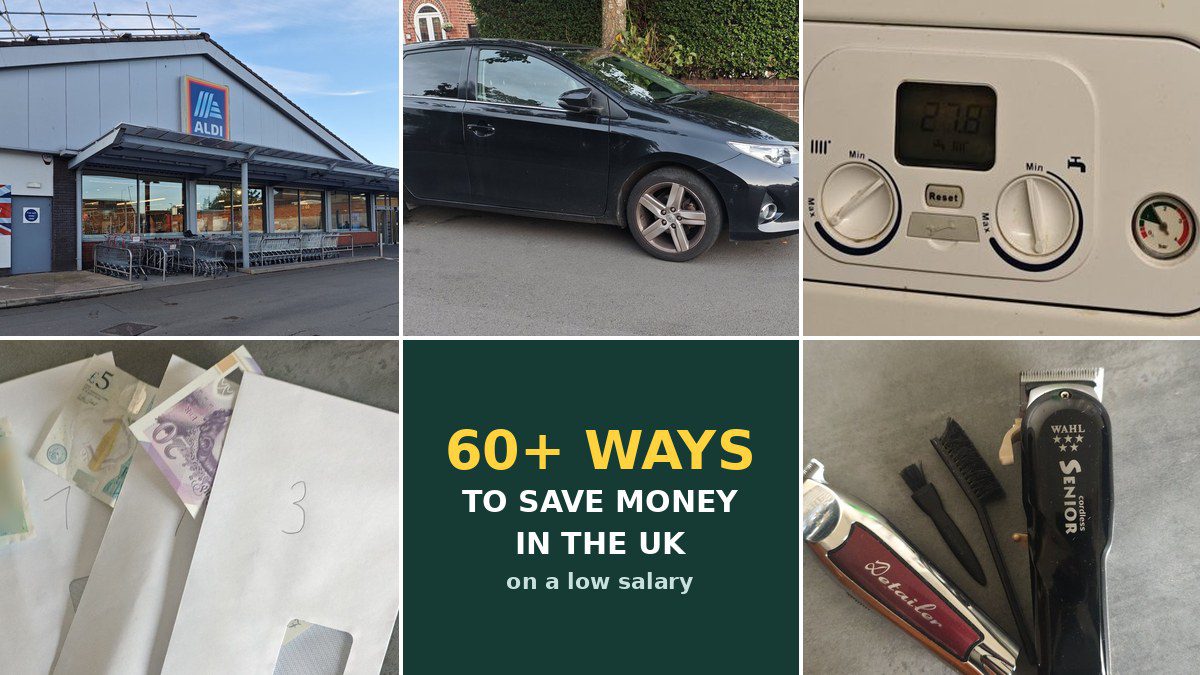
If you’re wondering how to save money in the UK, the quickest way is to cut your biggest regular bills first (energy, food, broadband and transport), claim back money you’re owed, and make sure your savings are earning proper interest. Below are 60+ practical ways I use on an average salary, grouped by topic, each linking to a step-by-step guide.
The hard part isn’t knowing what to do, it’s sticking with it. You’re sitting at your screen, tracking your budget, moving a bit of cash into savings, and a voice in the back of your mind starts whispering: “What is the point? Just forget it. Life is short, you only live once, just blow the lot and enjoy yourself.”
It is an incredibly easy mentality to fall into. Honestly, we see the results of that mentality all around us in the UK today with the cost of living crisis. When people face unexpected job losses or economic shocks, they end up trapped in a massive struggle simply because they didn’t have a backup plan, savings, or investments to lean on.
You don’t need a massive corporate wage to build a secure future. I’m an average salary earner, and I’m proof that small, consistent changes add up to a real financial safety net. But staying motivated when progress feels slow is a mental game, so after the tips I’ll share how I stick to the plan.

Table of Contents
Household Bills: Heating, Energy and Broadband
Your regular bills are where the biggest savings hide, because every pound you cut comes off every single month.
- Turn down the heating the smart way. Small changes to how and when you heat your home add up over a winter. Here’s how to save money on heating bills.
- Bleed your radiators. Cold spots at the top mean trapped air and wasted heat. No key? I use a screwdriver to bleed a radiator without a key.
- Heat one room, not the whole house. Our Warmlite halogen heater costs about 10.5p an hour on one bar. See the cheapest electric heater to run.
- Cut your wider energy use. Lights, appliances and standby all count. Here’s how to cut household energy bills.
- Check if you can get a free boiler. We got a new boiler and insulation for free through the ECO4 scheme. Here’s how the free boiler grant works.
- Ditch the tumble dryer. We don’t have one. An Aldi heated airer costs us about 6p an hour. Here’s how to dry clothes fast without a tumble dryer.
- Stop paying the loyalty penalty on broadband. Ring up at the end of your contract or switch. Here’s how to lower your broadband bill.
- Cut your phone bill. SIM-only deals are often a fraction of a contract. See how to save money on mobile phone bills.
- Trim streaming subscriptions. Rotate services instead of paying for all of them. Here’s how to save money on streaming services.
- Check your council tax band. Some homes are in the wrong band. Here’s how I lowered my council tax band.
- Look at your water bill. A water meter or a social tariff could cut it. Here’s how to slash your annual water bill.
Repairs and Replacing Things at Home
- Repair before you replace. When our fridge door seal went, I fixed it with a £25 seal instead of buying a new fridge. Here’s my guide to DIY appliance repair.
- Do the simple DIY jobs yourself. Sealant, shelves and small fixes don’t need a tradesperson. See how to save money on DIY repairs.
- Apply for a white goods grant. If money’s tight and your washing machine or fridge dies, a grant could replace it. Here’s how to get a white goods grant.
- Buy refurbished tech. Phones, laptops and tablets can cost far less refurbished. Here’s how to buy refurbished tech safely.
Food, Shopping and Everyday Spending
- Shop at the cheapest supermarket. I compared a real shop to see where it’s cheapest. See which is the cheapest supermarket in the UK.
- Plan your food shop. Our family food budget is usually around £40 to £50 a week. Here are my tips for saving money on grocery shopping.
- Cut back on takeaways. They’re one of the quickest budget leaks. Here’s how to save money on takeaways.
- Cut your own hair. I used to pay around £20 at the barbers every week. Now I use my own clippers. Here’s how I saved hundreds on haircuts.
- Swap the gym for the park. I cancelled my membership and go jogging in the park for free. Here’s how to cancel a gym membership.
- Spend less on clothes. See my tips to save money on clothes.
- Get school uniform for less. A lot of my daughter’s secondary school uniform came from local Facebook groups, some of it free. Here’s how to save money on school uniform.
- Don’t get sucked into Black Friday. A deal on something you didn’t need isn’t a saving. Here’s why I skip Black Friday.
- Give small, thoughtful Christmas gifts. We give each of our neighbours a box of chocolates and a card for £10. This year I compared prices in five shops to find the best deals on cheap Christmas gifts for neighbours.
Cars, Fuel and Getting Around
- Spend less on fuel. Driving style and where you fill up both matter. Here’s how to save money on fuel.
- Leave the car at home more often. Here’s how to cut your driving costs.
- Walk the school run. We swapped the car for walking to school, saving fuel and getting exercise. See the benefits of walking to school.
- Do basic car checks yourself. Oil, tyres and washer fluid are easy at home. See how to save money on car maintenance.
- Never auto-renew your car insurance. Compare quotes every year. Here’s how to save money on car insurance.
- Shop around for breakdown cover. I cut mine from £48 to £22. Here’s how to save money on breakdown cover.
- Know what your car really costs. Here’s what my 2014 Toyota Auris really costs to run.
- Claim when your train is late. Even a 15-minute delay can get you money back. Here’s how Delay Repay compensation works.
Family Days Out, Treats and Holidays
- Find where kids eat free. Lots of supermarket cafés and restaurants run kids’ deals, especially in the school holidays. See where kids eat free.
- Never pay full price for theme parks. Here’s how to get cheap theme park tickets.
- Go to the cinema for less. And skip the overpriced snacks. Here’s how to save money on cinema tickets.
- Book holidays on the right day. See the cheapest day to book a holiday.
- Spend less on kids’ birthday presents. See how to save money on kids’ birthday gifts.
- Claim your birthday freebies. Plenty of shops and restaurants give you something free on the day. See my birthday freebies UK list.
Banking, Debt and Budgeting
- Budget your salary the day it lands. Here’s my automated payday budgeting routine.
- Audit your bank statement. Forgotten subscriptions are easy to miss. Here’s how to do a bank statement audit.
- Do a money check-in as a couple. Here’s how our monthly finance date works.
- Get paid to switch banks. I’ve switched six times and made over £1,000 in bonuses. Here’s how to switch bank account.
- Use a free banking app. See my Monzo vs Starling vs Chase comparison.
- Get out of your overdraft. Overdraft interest is one of the most expensive ways to borrow. Here’s how to pay off an overdraft.
- Tackle credit card debt. I’ve got my own balance down from £1,200 to £900 using a 0% balance transfer. Here’s what to do if you’re struggling to pay credit card bills.
- Do a September money reset. See my 3-step financial reset.
Saving: Emergency Funds and Better Interest
- Build an emergency fund first. It stops a broken boiler or car repair turning into debt. Here’s how to build an emergency fund.
- Keep it in the right account. I keep around £10,000 in an easy-access account with Chase. See the best savings account for an emergency fund.
- Stop leaving money in low-interest accounts. Here’s how to stop wasting money on low-interest savings.
- Know how much interest is tax-free. See how much savings interest is tax-free in the UK.
- Get a 50% government bonus. If you’re working and on Universal Credit or certain other benefits, check out the Help to Save scheme.
- Decide if Premium Bonds are worth it. See Premium Bonds vs savings on a modest income.
- Try a savings challenge. See the 100 envelope challenge vs traditional budgeting.
- Start saving for your kids. See what I’d check first with a children’s savings account.
Earning Extra Money
- Do paid surveys in spare moments. I make around £100 a month from surveys. Here’s how to earn extra money in the UK and my guide to online surveys.
- Sell what you don’t use. Here’s how I sell on Facebook Marketplace.
- Enter free competitions. Here’s how to win online competitions without the spam.
- Turn your commute into income. See these active commuting side hustles.
- Understand matched betting before you try it. Read the truth about matched betting.
- Ask for a pay rise. It’s one of the quickest ways to boost your income for good. Here’s how to get a pay rise.
- Check you’re getting every benefit you’re owed. Use a benefits calculator.
- Claim Marriage Allowance. Married couples on a low salary could be missing out. Here’s how to claim the Marriage Allowance tax break.
Investing for the Long Term
Once you’ve got an emergency fund in place, it’s worth making your money work harder over the long term.
- Start with low-cost index funds. See my pick of the best index funds in the UK and my own investing journey.
- Choose the right platform. Here’s how to choose your first UK investment platform.
- Use your ISA allowance first. See Stocks and Shares ISA vs GIA.
- Don’t forget your pension. See saving for retirement on a low income.
- Think carefully about gold and crypto. I own physical gold sovereigns, but I also lost money in the FTX collapse. Read investing in gold coins and my Bitcoin story first.
How to Stay Motivated When Progress Feels Slow
The Beginning Is Always Slow
When you first start saving, it feels like watching paint dry. You look at your small monthly contributions and think, “At this rate, when am I ever going to see £50,000 or £100,000? How am I ever going to break free from the system?”
Social media doesn’t help. You see influencers flaunting quick riches, or you have mates telling you, “Why bother? You could get hit by a bus tomorrow.” True, any of us could go at any time. But living entirely for today while completely ignoring tomorrow is a trap.
It takes time, it takes patience, and it is mentally challenging to stick with it. I’ve been on this journey myself. There have been so many times I thought about stopping and just blowing my cash. I’ve made mistakes and I’ve lost money along the way, but I’m not afraid to admit it. Those down points are exactly how I learned to build the discipline I have today.
Trust the Snowball Effect
Here is the secret nobody tells you at the start: time flies.
You start saving and investing month after month. At first, it feels like nothing is happening. But then a year goes by, and you look back and think, “Wow, that actually wasn’t too hard.” Another year goes by, and suddenly, the little wins start compiling.
Budgeting, keeping on top of household bills and putting money aside all become second nature to you.
I experienced this firsthand. I started buying physical gold sovereigns a few years back. At the time, they felt expensive, but I kept clean, consistent habits. Today, if I were to sell those investments, I’d be looking at a very tidy profit. The same goes for the rest of my portfolio. I don’t want to sell them, but seeing that growth is proof that the system works.
Core Savings Strategies That Actually Work
Saving doesn’t require complex financial wizardry. By automating a fixed transfer into a high-interest savings account on payday and separating your long-term wealth building from your everyday spending, you remove temptation and let your money grow in the background without constant management.
The #1 Golden Rule: Don’t Check Your Accounts Every Day
If you want to stay sane while you save, stop obsessively checking your investment apps. Let your money grow in peace. By choosing simple, diversified paths, like an all-world index ETF, keeping a solid safety net in a separate savings account, and building a bit of extra cash on the side, the wins will come. You just have to give them breathing room.
What I Would Tell My Younger Self
If I could turn back the clock and talk to my younger self at my very first job, I’d give myself a serious talking to.
I would say: “Start saving just £50, £100, or £200 a month right now instead of wasting it on God knows what.” Looking at how the stock market, gold, and crypto have performed over the last couple of decades, I could have been looking at a very comfortable semi-retirement by now.
You can’t turn back the clock, but you can control what you do today.
Create a 15-to-20 Year Plan
If you want to get rich quick, my advice isn’t for you. Go find a “guru” who will sell you a dream. But if you want real, long-term security, you need a plan.
My personal plan is a 15-to-20 year strategy:
- Consistently build my long-term investments.
- Completely pay off the mortgage.
- Create a life where my fixed bills are so low that I have massive amounts of discretionary income to spend on the things I love doing.
I am not saying you should kill yourself or never go out. You absolutely should enjoy your life while the sun is shining. But be sensible.
Ten years from now, do you want to be the person who listened to the “live for today” crowd, standing there with an empty bank account, struggling and working non-stop just to pay basic bills? Or do you want to be the person who re-established their finances, stayed disciplined, and can now relax and enjoy the later years of life?
Stick to your plan. Be consistent. Over time, your money will grow, and your future self will absolutely look back and thank you for it.
What keeps you motivated when saving feels like a crawl? What would you tell your younger self about money? Let me know in the comments below!
