
With the colder evenings arriving, last week I got our heating ready for winter by bleeding every radiator in the house. And I didn’t use a radiator key once. All I needed was a flat-head screwdriver.
If a radiator is cold at the top but warm at the bottom, that’s the classic sign of trapped air, and it means you’re paying to run the heating without getting all the heat back. Bleeding fixes it, and on a lot of radiators you don’t need a special key to do it.
Here’s exactly how I did it, and how to bleed a radiator without a key on your own radiators.
Table of Contents
Why Bleeding Your Radiators Saves You Money
When air gets trapped at the top of a radiator, hot water can’t fill it properly. You get a cold patch at the top, the room takes longer to warm up, and your boiler works harder and burns more gas trying to reach the temperature on your thermostat.
Bleeding lets that trapped air out, so the whole radiator fills with hot water again. It’s free, it takes a few minutes per radiator, and it’s one of the easiest ways to get more heat for the same money. It’s also worth doing at the start of every winter, before the heating goes on for good.
Do You Actually Need a Radiator Key?
It depends on your bleed valve. Look at the small valve at one of the top corners of your radiator:
- If it has a slot across the middle (like a screw head), you can use a flat-head screwdriver. This is what ours look like, and it’s the easiest way to bleed a radiator without a key.
- If it has a small square pin in the middle, it’s designed for a radiator key. You can sometimes grip it gently with a pair of pliers or a multi-tool, but go carefully, because it’s easy to round off the edges. Radiator keys are cheap and sold at most DIY shops, hardware stores and supermarkets, so if you have square valves, a key is the safer option.
What You’ll Need
- A flat-head screwdriver that fits the slot snugly (or a radiator key)
- An old towel or cloth
- A small cup or container to catch drips
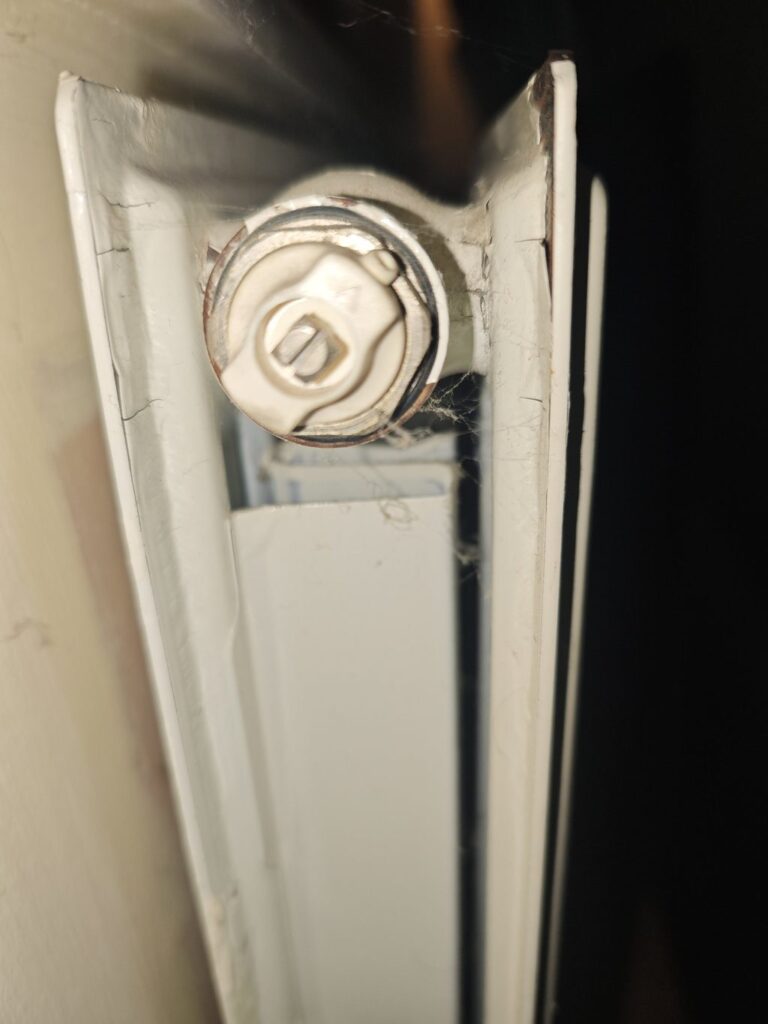
How to Bleed a Radiator Without a Key: Step by Step
- Turn your heating off and let the radiators cool. The water inside can be very hot, and bleeding a radiator while the pump is running can pull more air in. Give it at least half an hour.
- Start with the radiator furthest from your boiler. On a two-storey house, start downstairs and work your way up.
- Hold the towel and cup under the valve. A few drips of water are normal, and the water can be dirty, so protect your carpet and walls.
- Put the screwdriver in the slot and turn it anticlockwise slowly, about a quarter to half a turn. You should hear a hissing sound. That’s the trapped air escaping.
- Wait until the hissing stops and water starts to come out. Once you get a steady drip of water rather than air, all the air is out.
- Turn the screwdriver clockwise to close the valve. Make it snug, but don’t overtighten it.
- Repeat for every radiator in the house.
- Check your boiler pressure. This step is the one most people forget (more on it below).
- Turn the heating back on and check the radiators are now hot all over.
That’s exactly what I did last week. I turned each valve until the hissing stopped and a little water dripped out, closed it up, and moved on to the next one.
Don’t Forget to Top Up Your Boiler Pressure
Every time you let air and a little water out of your radiators, the pressure in your heating system drops. If it drops too low, your boiler may not fire up properly, or it may lock out altogether.
Once I’d finished all the radiators, I went to our Potterton boiler and topped the pressure back up. On most combi boilers you do this with the filling loop, usually a small tap or lever underneath the boiler, which lets mains water into the system. Open it slowly, watch the gauge, and close it again once the pressure is back in the right range.
For most boilers, that’s somewhere between 1 and 1.5 bar when the heating is off, but check your boiler’s manual, as every model is slightly different. If you’re not comfortable doing this yourself, or the pressure keeps dropping, call a Gas Safe registered engineer.
Quick Tips
- Bleed your radiators at the start of every winter. It’s much easier to do before you need the heating every day.
- If a radiator is cold at the bottom but hot at the top, that’s usually sludge rather than air, and bleeding won’t fix it.
- If one radiator keeps needing bleeding, there may be a leak or another problem in the system, so it’s worth getting it checked.
- Never use pliers roughly on the valve. A rounded-off valve is a much bigger job to fix than buying a £2 key.
Over to You!
Bleeding your radiators is one of those five-minute jobs that makes a real difference to how warm your home feels and how hard your boiler has to work. Pair it with a few other small changes and you’ll feel it on your bills. My guides to saving money on heating bills and the cheapest electric heater to run have more ideas for keeping warm this winter for less.
Have you bled your radiators yet this year? Let me know in the comments below!
Can I bleed a radiator with a screwdriver?
Yes, if your bleed valve has a slot across the middle. Use a flat-head screwdriver that fits the slot snugly and turn it slowly anticlockwise until the hissing stops and water appears, then close it again.
What can I use instead of a radiator key?
A flat-head screwdriver works on slotted bleed valves. On square valves designed for a key, you can sometimes grip them gently with pliers or a multi-tool, but it’s easy to damage the valve, so a cheap radiator key is safer.
Should the heating be on or off when bleeding radiators?
Off. Turn the heating off and let the radiators cool first, as the water can be very hot and bleeding with the pump running can draw more air into the system.
Do I need to top up my boiler after bleeding radiators?
Usually, yes. Bleeding lets out a little water, which lowers the pressure. Check the gauge on your boiler and top it up using the filling loop if needed. Most boilers need around 1 to 1.5 bar when the heating is off, but check your manual.
